
Work starts on National Action Plan for the Lesser White-fronted Goose in Kazakhstan
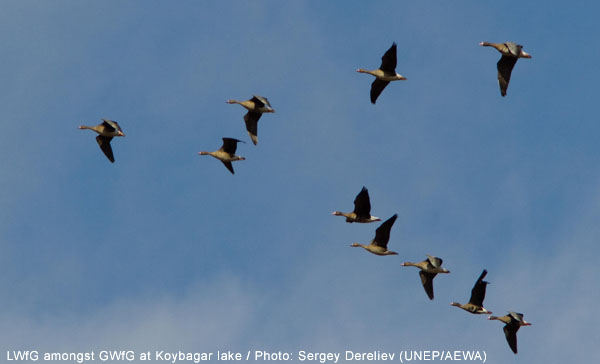
Bonn, 19 October 2010 - At a two day national workshop on the Lesser White-fronted Goose (Anser erythropus) in Kostanay in northern Kazakhstan last week (12 – 14 October 2010) participants agreed on a basic structure for a National Action Plan for the Conservation of the Lesser White-fronted Goose – including main threats and activities - for Kazakhstan.
The meeting was chaired by the Kazakhstan national representative to the AEWA International Lesser White-fronted Goose Working Group, Mr. Bakytbek Duisekeyev from the Committee of Forestry and Hunting and was facilitated by AEWA Technical Officer Mr. Sergey Dereliev. The meeting was also attended by Mr. Tomas Aarvak from the Norwegian Ornithological Society who took part in the meeting in his capacity as international Lesser White-fronted Goose expert and Ms. Nina Mikander, the Coordinator for the Lesser White-fronted Goose based at the UNEP/AEWA Secretariat.
Kazakhstan is one of the most important range states for the globally threatened LWfG as the entire Western main population is thought to stage in northern Kazakhstan in the Kostanay region during spring and autumn migration. In addition, a varying number of individuals from the Fennoscandian population migrate through the area in autumn on the way to southern Europe. The national conservation work in Kazakhstan will hopefully serve as a positive example for other LWfG range states in the process of starting national conservation activities for the species.
 |
 |
 |
The meeting commenced with the decision to form a National Working Group for the species to guide the drafting of the Action Plan as well as to coordinate implementation after its adoption. The Working Group will include government officials, LWfG experts, representatives from hunters’ organizations and NGOs as well as other important stakeholders – all of which were represented at the workshop.
After presentations on the international conservation status of the species and the implementation of the International Single Species Action Plan for the LWfG Kazakhstani experts elaborated on the legal situation and biological status of the species (the LWfG has been included in Kazakhstan’s Red Book for endangered species since 2008) as well as the view of the hunters’ organizations. Russian expert Ms. Sonia Rozenfeld from the Geese and Swans Study Group of Eastern Europe and North Asia also gave an update on the current population estimate based on the 2010 autumn monitoring mission which took place just prior to the workshop.
Mr. Dereliev then led a group discussion on the main threats to the species in Kazakhstan followed by an analysis of the causes. Not surprisingly the threat from hunting was reaffirmed as the major cause of mortality of LWfG in Kazakhstan. Hunting LWfG is illegal, and a system of fines and court proceedings exist - though poachers are seldom caught and prosecuted. Legal goose hunting was also deemed a problem, as many LWfG are killed as a result of incidental shooting. In general it was concluded that the hunting culture – at least concerning waterfowl – is quite low in Kazakhstan. Hunting skills, in particular with regard to species recognition, need to be improved. Disturbance through hunting on other species is also severe, especially during spring migration when the duck hunting season can coincide with the staging of Lesser White-fronted Geese in Kostanay.
On day two of the workshop, the group concentrated on setting goals and objectives for the action plan based on the threats identified in the problem analysis. The overall goal in the Kazakh Action Plan for the Western main population will be identical to that of the International Action Plan: to raise and maintain the population size at not less than 25,000 individuals. Activities to decrease the threat from hunting will include developing a flexible system to close hunting in key sites during spring and autumn migration when LWfG are present in large numbers and increasing the control of game husbandries where the hunting takes place.
The national action plan will be drafted
by Dr. Sergey Yerokhov from the Kazakhstan Agency for Applied
Ecology
and Dr. Sergey Sklyarenko from the Association on the
Conservation of Biodiversity of Kazakhstan (ACBK) on the
basis of the
objectives, indicators and activities identified during
the workshop. The draft will then be submitted to the national
working group for comments and further to the Committee
for Forestry and Hunting for approval.
 |
 |
 |
The workshop was rounded off on day three by an optional excursion to the lakes Koybagar and Tiuntiugur east of the city of Kostanay.
The LWfG National Action Planning workshop was funded by the German Federal Ministry for the Environment, Nature Conservation and Nuclear Safety and the Finnish Ministry of the Environment. The monitoring mission carried out the week prior to the workshop was funded by the Norwegian Directorate for Nature Management. Both monitoring mission and the meeting were organized by ACBK, the Kazakhstan Agency for Applied Ecology and the UNEP/AEWA Secretariat.
For more information please see the International Single Species Action Plan:
- ACBK article (available in Russian only)
or please contact:
Ms. Nina Mikander, Coordinator for the Lesser White-fronted Goose