
Whooper swan Y6K ignores volcanic ash flight restrictions and makes it safely to Iceland
It is a truly remarkable story to tell. While air travel across large parts of Europe came to a complete standstill as a result of the volcanic eruption in Iceland on 14 April 2010, a single satellite tagged Whooper swan (Cygnus cygnus) made headlines as it braved the volcanic ash cloud and made it safely to its breeding grounds in Iceland.
 Background
to the story is the Whooper swan satellite-tracking project,
being conducted by the Wildfowl & Wetlands Trust (WWT),
which aims to describe the migration routes and flight heights
of Whooper swans in relation to offshore wind farm sites.
The major eruption of the volcano under the Eyjafjallajokull
glacier not only brought air traffic in Europe to a halt,
but also caused worries for the well-being of migrating
Whooper swans and other waterbirds on their way to their
Icelandic breeding grounds.
Background
to the story is the Whooper swan satellite-tracking project,
being conducted by the Wildfowl & Wetlands Trust (WWT),
which aims to describe the migration routes and flight heights
of Whooper swans in relation to offshore wind farm sites.
The major eruption of the volcano under the Eyjafjallajokull
glacier not only brought air traffic in Europe to a halt,
but also caused worries for the well-being of migrating
Whooper swans and other waterbirds on their way to their
Icelandic breeding grounds.
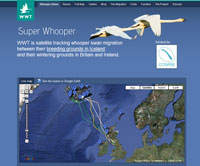
Concerns increased when it became clear that a single satellite tagged swan (Y6K) being tracked in the framework of the project had chosen to migrate at just the wrong time. Having originally migrated direct from Iceland to Ireland last autumn, he moved via Kintyre to the area around the Solway in mid-winter. On 12 April he started heading north from Dumfriesshire and had reached the Outer Hebrides by the morning of 13 April. That evening he set off for Iceland and by early the following evening he was more than half-way across. After spending the night on the water he made much slower headway on the morning of 15 April and seemed to be veering a little off course before turning and heading northwesterly again towards Iceland. The southeasterly winds pushing the ash cloud towards Britain meant that Y6K was effectively flying into head winds, which may well explain why it took him 4.5 days to cross from the Outer Hebrides to Iceland. But he finally came in over east Iceland at mid-day on 17 April and spent the next 24 hours resting in fields near Höfn. It is of course difficult to determine the extent to which he changed direction to avoid coming in near the volcano; he should certainly have been able to see the plume whilst still out at sea.
In the end, swan Y6K safely arrived in Iceland, although concerns regarding the well-being of Icelandic-breeding goose and swan populations over the coming months remain. Because the vast majority of migratory birds fly at altitudes of 7,000 meters or less where the ash cloud is drifting around, there is no doubt that they are also being exposed to the ash. Since birds are more sensitive than humans to airborne toxins and lung dysfunction, it is most likely that many birds are being negatively impacted. According to a report from Dr Olafur Einarsson from the Icelandic Institute of Natural History in Reykjavik and a colleague from WWT, bird deaths have occurred during previous eruptions of other volcanoes in Iceland, when the feeding areas were covered with ash, causing major problems for farmers and birds. Fortunately at the moment the main area affected, between Vik (in the west) and Kirkjubaejarklaustur (in the east), is primarily an area of sand and gravel, leaving internationally important whooper swan staging or breeding sites still suitable for swans. Nevertheless, WWT and Icelandic colleagues will continue to monitor any impact on the swan and goose populations breeding in Iceland this summer, both during the summer months and following their migration to Britain and Ireland next autumn.
Further Information:
For more information on the Whooper swan story and the satellite-tracking project being carried out by the Wildfowl & Wetlands Trust (WWT) see the following links:
- http://www.wwt.org.uk/whooper
- http://www.wwt.org.uk/latest-news/fears-for-whooper-swan-as-it-disappears-into-volcanic-cloud
- http://www.wildlifeextra.com/go/news/whooper-iceland.html#cr
- http://scienceblogs.com/grrlscientist/2010/04/how_are_birds_affected_by_volc.php
- http://www.surfbirds.com/sbirdsnews/archives/2010/04/fears_for_whoop.html