
Scotland and Northern Ireland take emergency measures to reduce disturbance to waterbirds during severe cold winter - UK hunting organisations call for extra voluntary restraint
The measures are part of a carefully elaborated scheme developed in Great Britain to reduce the disturbance to waterbirds during periods of prolonged cold weather.
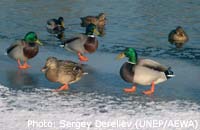 For
many waterbirds, midwinter can be an ecological “bottle-neck”
during which they have difficulty obtaining enough food,
especially in times of severe cold weather when the ground
is frozen. In such conditions many birds face difficulties
in feeding and roosting due to extensive snow and ice
covering their habitats. In addition to facing reduced
prospects for survival, many birds adapt their behaviour
to the cold weather by saving their remaining energy reserves
and appear to be “tame” as they are reluctant
to fly away when approached.
For
many waterbirds, midwinter can be an ecological “bottle-neck”
during which they have difficulty obtaining enough food,
especially in times of severe cold weather when the ground
is frozen. In such conditions many birds face difficulties
in feeding and roosting due to extensive snow and ice
covering their habitats. In addition to facing reduced
prospects for survival, many birds adapt their behaviour
to the cold weather by saving their remaining energy reserves
and appear to be “tame” as they are reluctant
to fly away when approached.
The call for voluntary restraint from shooters and the statutory suspension aim to reduce disturbance to the birds caused by waterfowl shooting in order to help them conserve their limited energy reserves and maintain body condition to see them through the difficult period. Conservation bodies have also urged reduction of other forms of waterbird disturbance, such as recreational activities near coasts or frozen waterbodies.
“Although it has been 13 years since shooting was last legally suspended in a British severe winter, the suspension of shooting in Scotland and Northern Ireland has been straightforward. This is due to the well-understood procedures having been previously agreed between the various parties involved (government departments and their statutory agencies, and UK shooting and conservation NGOs).” said David Stroud, Senior Ornithologist at the Joint Nature Conservation Committee – the British government’s UK nature conservation advisory body.
The system and the underlying protocol leading to the temporary legal suspension of waterfowl shooting during extreme cold weather has been operational in the United Kingdom since 1981 and has been progressively refined in the years since.
Once severe weather fulfils previously agreed criteria, the British Association for Shooting and Conservation (BASC) and other hunting organisations normally call on Britain’s waterfowl hunters to exercise voluntary restraint in shooting where appropriate. Once stricter criteria are met (after thirteen days of continuous severe cold weather), the relevant Secretary of State(s) have the power under Section 2 (6) of the Wildlife and Countryside Act to impose a Protection Order which temporarily (up to a total of fourteen days) suspends the shooting of waterbirds.
“As in previous years, conflicts have been avoided by all involved having clearly agreed as to those conditions that will trigger a statutory suspension of shooting, as well as the maintenance of frequent and good communications between all involved.” said Stroud.
John Harradine (Director of Research) at the British Association for Shooting and Conservation (BASC) added: “Part of the agreed procedures is for BASC, in conjunction with key partners, to consider a call for extra restraint in waterfowl hunting once the severe weather has lasted at least seven days. This is a call for voluntary action depending on the local conditions and needs of the hunted waterfowl. It would last as long as and wherever conditions were difficult and up to the start of any full statutory suspension. This winter voluntary restraint by hunters was widely practised in all parts of the United Kingdom and even continued where still needed in Scotland after its statutory suspension was lifted.”
“The operation of this system perhaps provides wider lessons as to how countries should prepare for other emergencies, or rapidly developing situations which have the potential to affect waterbirds.” said Stroud.
“It underlines that contingency planning in advance is totally essential so that all parties clearly understand their roles and are not having to rapidly make-up policy ‘in real time’. And also that following each time we have such an incident, we have a full review of the procedures the following spring, involving all parties, to thoroughly de-brief ourselves and see what lessons can be learnt for the future. That feedback loop is totally essential to continue to improve procedures” stressed Stroud.
The UK system is a prominent example of a national emergency response by one country to try to minimize the effects of extreme cold weather on waterbirds in the AEWA region. It may contain elements that would be of wider applicability to other countries interested in developing a similar system, not only for those countries that lie close to the frost-line in the northern winter and support large numbers of wintering waterbirds, but also for other temperate countries given predications of increasingly variable future climate. Future periods of extreme cold may occur in countries where these have not been typical.
The AEWA Action Plan requires that Parties shall develop
and implement emergency measures for waterbird populations,
when exceptionally unfavourable or endangering conditions
occur, such as extreme weather. The protocol for the introduction
of a temporary shooting ban in the United Kingdom is also
featured as a case study in the section on “Extreme
weather” in the AEWA
Conservation Guidelines (p. 6) on identifying
and tackling emergency situations for migratory waterbirds
and the British system has also been thoroughly reviewed
in a paper in the Edinburgh proceedings (see link to the
full
article below).
For more information please visit:
- JNCC Website: Reducing disturbance to waterfowl during severe winter weather
- BASC Website: Severe Weather & Call for Voluntary Restraint
- AEWA Conservation Guidelines: Guidelines on identifying and tackling emergency situations for migratory waterbirds. (PDF Document)
- Article: Stroud, D.A., Harradine, J., Shedden, C., Hughes, J.,Williams, G., Clark, J.A. & Clark, N.A. 2006. Reducing waterbird mortality in severe cold weather: 25 years of statutory shooting suspensions in Britain. Waterbirds around the world. Eds. G.C. Boere,C.A. Galbraith & D.A. Stroud. The Stationery Office, Edinburgh, UK. pp. 784-790.