
The Russian Government convenes workshop to further discuss its accession to AEWA
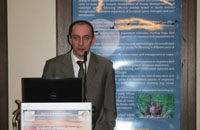 Hannover,
2 December 2011 - The Ministry of Natural
Resources and Environment of the Russian Federation
organized a one-day
workshop aiming at identifying international cooperation
mechanisms for the conservation of migratory waterbirds
and also for hunting regulations. The workshop was held
in the margins of the exhibition “Horse and Hunt” at
the Exhibition Centre in Hannover, Germany. The workshop
had a clear focus on the conservation of migratory waterbirds
in the Eurasian part of the Russian Federation. In this
context, participants reviewed the role of CMS and in particular
of AEWA and its potential for the Russian Federation. In
addition, the concrete terms under which the Russian Government
could ratify AEWA were discussed.
Hannover,
2 December 2011 - The Ministry of Natural
Resources and Environment of the Russian Federation
organized a one-day
workshop aiming at identifying international cooperation
mechanisms for the conservation of migratory waterbirds
and also for hunting regulations. The workshop was held
in the margins of the exhibition “Horse and Hunt” at
the Exhibition Centre in Hannover, Germany. The workshop
had a clear focus on the conservation of migratory waterbirds
in the Eurasian part of the Russian Federation. In this
context, participants reviewed the role of CMS and in particular
of AEWA and its potential for the Russian Federation. In
addition, the concrete terms under which the Russian Government
could ratify AEWA were discussed.
Participants included representatives of the Russian government and relevant Russian institutions, the Federation of Associations for Hunting and Conservation of the European Union (FACE), the International Council for Game and Wildlife Conservation (CIC), BirdLife International, European Institute for the Management of Wild Birds and their Habitats (OMPO) and the IUCN/WI Goose Specialist Group. UNEP/AEWA and UNEP/CMS Secretariats were represented by Mr. Bert Lenten (CMS Deputy Executive Secretary), Ms. Catherine Lehmann (UNEP/AEWA Programme Officer) and Ms. Christiane Röttger (CMS Coordinator for the Central Asian region).
In his opening speech, Mr. Anton Bersenev, Director of Department of State Policy and Regulation in Hunting Management and Animal Resources at the Ministry of Natural Resources and Environment of the Russian Federation, highlighted the Ministry’s intention to establish international cooperation mechanisms in the country for the management of migratory waterbirds. With regard to a possible accession of the Russian Federation to AEWA, he pointed out that the Ministry was especially interested in the potential of AEWA as a tool for game management, although the Russian Government would have reservations on some of the specific provisions of the AEWA Action Plan, notably those concerning the use of lead shot for hunting in wetlands and spring hunting.
The participants delivered 14 presentations touching upon different key areas of waterbird conservation and management in Russia and Europe. This workshop served as a first opportunity to make contact with experts from some key organizations in Russia and at a global level, and to exchange recent developments in various regions and fields of work. Mr. Bersenev expressed the Ministry’s intention to host a larger meeting in 2012 to bring together national and international experts involved in the conservation and management of migratory waterbirds and to explore further cooperation at the international level. Hopefully, this workshop will launch the process of the Russian Federation towards accession to AEWA.
A set of recommendations summarizing the outcome of the workshop will shortly be made available on the AEWA website.
The UNEP/AEWA Secretariat had organized a two-day workshop to promote the accession of the Russian Federation to AEWA in March 2010 and welcomes this latest measure which will further strengthen the cooperation with the Russian Government.
For more information:
- The workshop’s recommendations
- CIC statement at the occasion of the workshop
- Moscow
workshop – a further step towards promoting
Russian accession to AEWA