

Migratory birds don’t stop at borders. Policy shouldn’t either.
Guest Op-Ed by Dr. Musonda Mumba, Secretary General of the Convention on Wetlands to mark World Migratory Bird Day 2026
They travel thousands of kilometres each year, returning to the same wetlands with a precision that puts the compass and GPS to shame. What migratory birds depend on, however, is far less reliable.
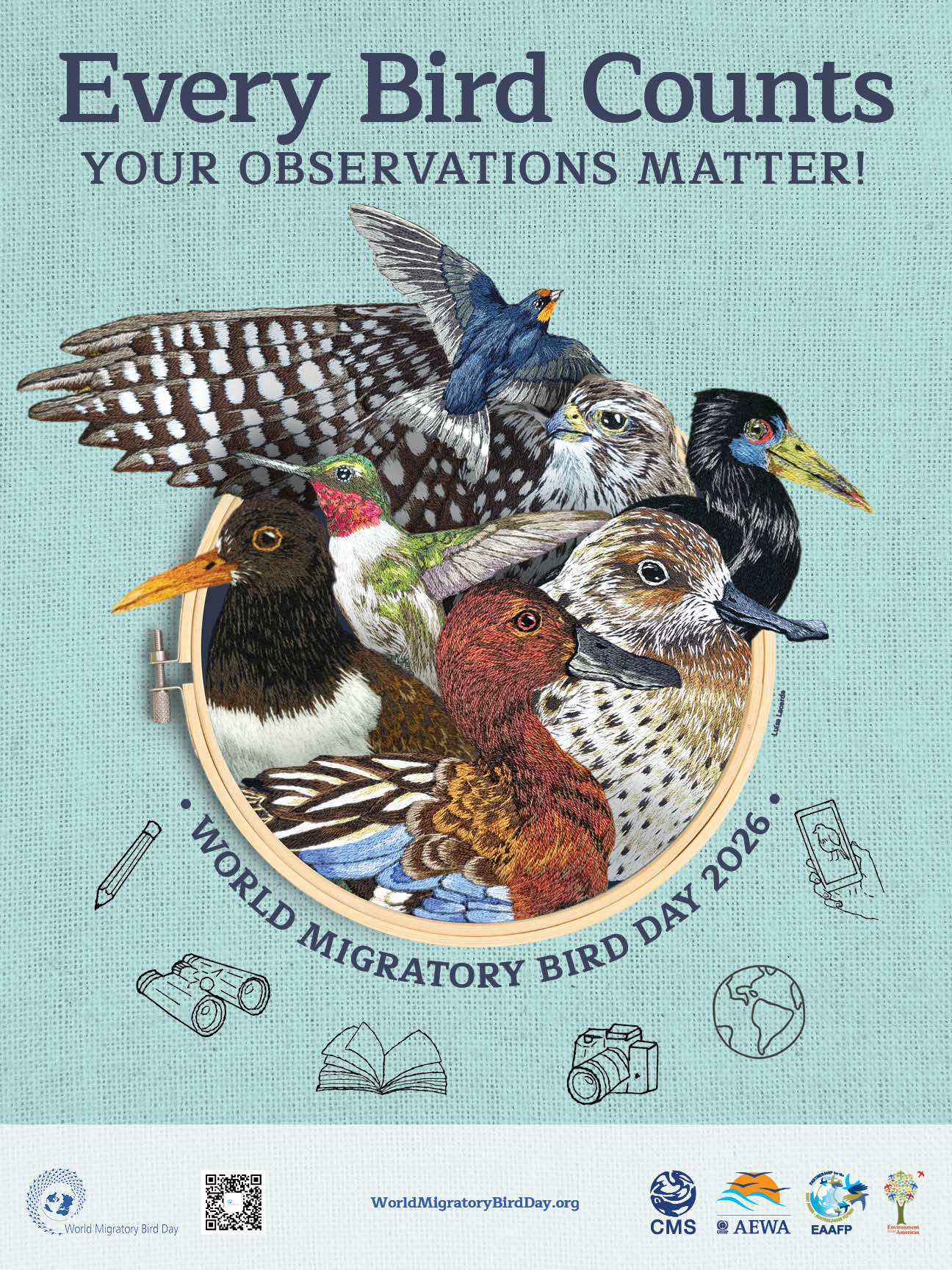
On 9 May, World Migratory Bird Day—coordinated by a coalition of partners that include the Convention on Migratory Species (CMS), the African-Eurasian Migratory Waterbird Agreement (AEWA), the East Asian-Australasian Flyway Partnership (EAAFP) and Environment for the Americas (EFTA)—will once again turn attention to these journeys. This year’s theme on the importance of citizen science for the conservation of migratory birds, brings into focus the thousands of people who track and record these birds, often over long periods of time, for the benefit of science and conservation all over the world. It has also been a year since governments meeting in Victoria Falls at the Ramsar Convention on Wetlands COP15 agreed to improve the way those routes are protected.
The Convention on Wetlands waterbird flyways resolution, “Strengthening national actions for the conservation and restoration of waterbird flyways”, adopted at COP15 reinforces the concept that conservation has to operate at the scale of the flyway. A protected site here or there is not enough if the chain breaks elsewhere.
Migratory birds depend on continuity, as their wetland and other habitats are not isolated, but form connected points along routes that stretch across countries and regions. When one is lost or degraded, this impacts the entire chain of sites and habitats on which they depend.
The response set out in the resolution is deliberately practical. Countries committed to improving monitoring, updating national plans, and working more closely through existing frameworks such as the African-Eurasian Migratory Waterbird Agreement and the East Asian–Australasian Flyway Partnership. The emphasis was on using what already exists with greater discipline.
That effort rests, in part, on one of the longest-running examples of citizen science in conservation – the International Waterbird Census (IWC). Each year, tens of thousands of volunteers take part in coordinated waterbird counts across the world’s wetlands—often in difficult conditions, and often with little visibility beyond specialist circles. Those counts are delivered through national monitoring schemes and feed global datasets, forming the backbone of the evidence used to assess the world’s waterbird population trends and guide international and national policy decisions.
Effective conservation of migratory waterbirds and their habitats depend on access to more and better information. Patchy data has made it difficult to track population trends or formulate tangible conservation targets. The Waterbird Estimates Partnership was designed to close that gap, bringing together datasets that have until now been siloed or scattered.
None of this is especially contentious. The science is well established, and the mechanisms for cooperation are already in place. What remains difficult is the ability to act on that knowledge, particularly where monitoring capacity is limited or funding is uncertain—gaps that were acknowledged at COP15 and have yet to close.
A year on, the resolution continues to serve as a practical framework that brings together data collection, policy alignment, and international cooperation in a way that is more easily accessible to Contracting Parties and organisations.
World Migratory Bird Day is a good occasion to remind us of the wonder of bird migration, but also of the importance of international cooperation for the conservation of migratory birds and wetlands.
Migratory birds will continue to move as they always have, following routes that their ancestors have been flying for tens of thousands of years. Whether those routes remain intact depends on decisions taken far from the birds themselves—in national plans, in monitoring budgets, and by the hundreds of thousands of citizen scientists who make this work possible.