
In Focus: AEWA Conservation Guideline No. 7 - Guidelines on the Development of Ecotourism at Wetlands
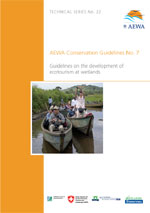 Bonn, 28 March 2013 - Tourism is an important
source of income for many countries. Nature-related tourism
is a world-wide phenomenon that is expanding rapidly.
However nature-related tourism is only profitable in the
long run if it is managed in a sustainable way. If the
ecotourism industry can be made to realize this then tourism
could become an important tool for stimulating nature
conservation.
Bonn, 28 March 2013 - Tourism is an important
source of income for many countries. Nature-related tourism
is a world-wide phenomenon that is expanding rapidly.
However nature-related tourism is only profitable in the
long run if it is managed in a sustainable way. If the
ecotourism industry can be made to realize this then tourism
could become an important tool for stimulating nature
conservation.
Ecotourism may be defined as nature tourism that contributes to nature conservation. In a well-managed ecotouristic region, the right balance is struck between use and preservation.
In Paragraph 4.2.1 of the AEWA Action Plan, Parties are required to encourage, where appropriate, the elaboration of cooperative programmes to develop sensitive and appropriate ecotourism in wetlands. Furthermore, in Paragraph 4.2.2, Parties are required, in cooperation with competent international organisations, to endeavour to evaluate the costs, benefits and other consequences that can result from ecotourism at wetlands with concentrations of waterbirds.
Ecotourism is the only form of tourism acceptable in most of the AEWA region. Many countries have yet to make full use of the possibilities for ecotourism at their important wetlands, and it is here that the development of ecotourism should be promoted.
These guidelines examine a wide range of issues relating
to nature-oriented tourism in general and offer practical
advice for the development of responsible ecotourism in
wetlands important for migratory birds.
For more information please visit:
http://www.unep-aewa.org/publications/conservation_guidelines.htm
| Overview of all AEWA Conservation Guidelines | |
| Guideline No. 1 | Guidelines
on the preparation of National Single Species Action
Plans for migratory waterbirds |
| Guideline No. 2 | Guidelines on identifying and tackling emergency situations for migratory waterbirds |
| Guideline No. 3 | Guidelines on the preparation of site inventories for migratory waterbirds |
| Guideline No. 4 | Guidelines on the management of key sites for migratory waterbirds. |
| Guideline No. 5 | Guidelines on sustainable harvest of migratory waterbirds |
| Guideline No. 6 | Guidelines on regulating trade in migratory waterbirds. |
| Guideline No. 7 | Guidelines on the development of ecotourism at wetlands |
| Guideline No. 8 | Guidelines on reducing crop damage, damage to fisheries, bird strikes and other forms of conflict between waterbirds and human activities |
| Guideline No. 9 | Guidelines for a waterbird monitoring protocol |
| Guideline No. 10 | Guidelines on Avoidance of Introductions of non-native Waterbird Species. |
| Guideline No. 11 | Guidelines on how to avoid, minimize or mitigate impact of infrastructural developments and related disturbance affecting waterbirds |
| Guideline No. 12 | Guidelines on measures needed to help waterbirds to adapt to climate change |
| Guideline No. 13 | Guidelines on the translocation of waterbirds for conservation purposes: Complementing the IUCN Guidelines (available soon) |
| Guideline No. 14 | Guidelines on how to avoid or mitigate impact of electricity power grids on migratory birds in the African-Eurasian region (available soon) |