
In Focus: AEWA Conservation Guideline No. 5 - Guidelines on Sustainable Harvest of Migratory Waterbirds
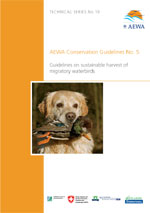 Bonn, 12 December 2012 - If populations of migratory
waterbirds are to be maintained in a favourable conservation
status, it is essential that any exploitation of these
populations be carried out on a sustainable basis. Article
III, paragraph 2 (b) of the Agreement requires that Parties
ensure that any use of migratory waterbirds is based on
an assessment of the best available knowledge of their
ecology, and is sustainable for the species as well as
for the ecological systems that support them.
Bonn, 12 December 2012 - If populations of migratory
waterbirds are to be maintained in a favourable conservation
status, it is essential that any exploitation of these
populations be carried out on a sustainable basis. Article
III, paragraph 2 (b) of the Agreement requires that Parties
ensure that any use of migratory waterbirds is based on
an assessment of the best available knowledge of their
ecology, and is sustainable for the species as well as
for the ecological systems that support them.
More specifically, in paragraph 4.1.1 of the Action Plan, Parties are required to co-operate to ensure that their hunting legislation implements the principle of sustainable use as envisaged in the Action Plan, taking into account the full geographical range of the waterbird populations concerned and their life history characteristics.
The present guidelines promote the establishment of 'harvest frameworks' at both international and national levels, and identify a series of steps to assist Range States in adopting a sustainable approach to the harvesting of waterbirds. These steps include, for example, the introduction of procedures to maintain high standards amongst hunters; the commitment to and the support of international harvest management or the adjustment of harvest frameworks to address national objectives.
A series of twelve Conservation Guidelines, which deal with inter alia, species and habitat management and management of human activities has been developed to assist the Parties in the implementation of the AEWA Action Plan.
Guidelines 2, 6 and 10 were revised by the AEWA Technical Committee and adopted by the 5th Meeting of the Parties to AEWA (MOP5) in May 2012. In addition two newly developed Conservation Guidelines; Guidelines on How to Avoid or Mitigate Impact of Electricity Power Grids on Migratory Birds in the African-Eurasian Region and Guidelines for the Translocation of Waterbirds for Conservation Purposes: Complementing the IUCN Guidelines were adopted by MOP5. The revised and newly developed guidelines will be published in due course.
For more information please see:
http://www.unep-aewa.org/publications/conservation_guidelines.htm
| Overview of all AEWA Conservation Guidelines | |
| Guideline No. 1 |
Guidelines on the preparation of National Single
Species Action Plans for migratory waterbirds. |
| Guideline No. 2 | Guidelines on identifying and tackling emergency situations for migratory waterbirds. |
| Guideline No. 3 | Guidelines on the preparation of site inventories for migratory waterbirds. |
| Guideline No. 4 | Guidelines on the management of key sites for migratory waterbirds. |
| Guideline No. 5 | Guidelines on sustainable harvest of migratory waterbirds. |
| Guideline No. 6 | Guidelines on regulating trade in migratory waterbirds. |
| Guideline No. 7 | Guidelines on the development of ecotourism at wetlands. |
| Guideline No. 8 | Guidelines on reducing crop damage, damage to fisheries, bird strikes and other forms of conflict between waterbirds and human activities. |
| Guideline No. 9 | Guidelines for a waterbird monitoring protocol. |
| Guideline No. 10 | Guidelines on avoidance of introductions of non-native waterbird species. |
| Guideline No. 11 | Guidelines on how to avoid, minimize or mitigate impact of infrastructural developments and related disturbance affecting waterbirds. |
| Guideline No. 12 | Guidelines on measures needed to help waterbirds to adapt to climate change. |