
European Seaduck Populations in Steep Decline
 Bonn
/ Slimbridge, 1 December 2011 - “The conservation
status of seaduck populations in north and west European
waters is of rapidly increasing concern,” warn
two senior experts from the United Kingdom and Denmark
in a recently published “Overview of the status
of European seaducks and actions required for their conservation”.
Bonn
/ Slimbridge, 1 December 2011 - “The conservation
status of seaduck populations in north and west European
waters is of rapidly increasing concern,” warn
two senior experts from the United Kingdom and Denmark
in a recently published “Overview of the status
of European seaducks and actions required for their conservation”.
According to the note, monitoring data indicates that many seaduck populations are now in steep decline, with little information available on the demographic explanation for this, or the likely environmental causes.
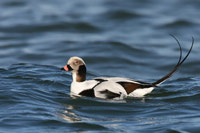
Recent coordinated surveys from the Baltic Sea1 (the key wintering area for most seaduck species) indicate that most seaduck species there are currently experiencing significant declines. For example, Long-tailed Duck has declined by as much as 65% since the previous coordinated survey in 1992-93.
The two duck researchers say, declines in seaduck numbers have also been noted within other parts of Europe, as well as in North America.
Whilst the basic trends appear clear, knowledge is currently lacking on the possible causes of these observed declines and how they impact seaducks demographically. Clearly, a number of potential threats exist (e.g. by-catch in fishing nets, reductions in nutrient loads, over-harvesting or small oil spills and other forms of pollution), but the effect of these factors on seaduck abundance is poorly understood.
“There is an urgent need to diagnose the causes of the observed declines, and improve our knowledge of the status of these populations, and the threats they face.” said Richard Hearn, from the Wildfowl & Wetlands Trust and the IUCN-SSC/WI Duck Specialist Group, who is one of the authors of the overview. “A conservation planning workshop is urgently needed to take this process forwards in a coordinated and effective manner, and it is essential this is carried out at a population (flyway) scale, which will require international cooperation.” underlines Hearn.
“A clear framework and an internationally agreed way forward to address seaduck conservation in Europe is urgently needed if the rapid declines of many of these seaducks are to be halted” says Hearn, “Such an approach is also required in order to meet international conservation obligations, such as those set out in the EU Birds Directive, the African-Eurasian Waterbird Agreement (AEWA) and the Aichi global biodiversity targets.” says Hearn.
To read the full “Overview of the status of European seaducks and actions required for their conservation” please click here.
The overview was prepared and submitted
to the UNEP/AEWA Secretariat by:
Richard Hearn, IUCN-SSC/WI Duck Specialist Group, c/o
Wildfowl & Wetlands
Trust, Slimbridge, Glos. GL2 7BT, United Kingdom: [email protected] and
Henrik Skov, Senior Ecologist, DHI, Agern Allé 5,
DK-2970 Hørsholm, Denmark: [email protected]
___________________________
1Skov H, Heinänen S, ydelis R, Bellebaum J, Bzoma S, Dagys M, Durinck J, Garthe S, Grishanov G, Hario M, Kieckbusch JJ, Kube J, Kuresoo A, Larsson K, Luigujoe L, Meissner W, Nehls HW, Nilsson L, Petersen IK, Mikkola-Roos M, Pihl S, Sonntag N & Stipniece A. 2011. Waterbird populations and pressures in the Baltic Sea. Nordic Council of Ministers, Copenhagen.
Further information:
- WWT news release: Thousands of seaducks go missing
- Overview of the status of European seaducks and actions required for their conservation
- BirdLife International: Baltic seaduck take a dive