
The Arctic Biodiversity Assessment _ Migratory Birds
 Kiruna,
15 May 2013 - The Conservation of Arctic Flora and
Fauna (CAFF),
the biodiversity working group of the Arctic Council has
released the “Arctic Biodiversity Assessment (ABA),”
a report containing the best available science informed
by traditional ecological knowledge on the status and trends
of Arctic biodiversity and accompanying policy recommendations
for biodiversity conservation –
www.arcticbiodiversity.is
Kiruna,
15 May 2013 - The Conservation of Arctic Flora and
Fauna (CAFF),
the biodiversity working group of the Arctic Council has
released the “Arctic Biodiversity Assessment (ABA),”
a report containing the best available science informed
by traditional ecological knowledge on the status and trends
of Arctic biodiversity and accompanying policy recommendations
for biodiversity conservation –
www.arcticbiodiversity.is
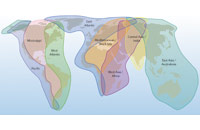
Migratory species: Millions of migratory birds connect the Arctic with the entire globe and uniquely adapted marine mammal species swim in Arctic seas. A key finding of the ABA is that many Arctic migratory species are threatened by overharvest and habitat alteration outside the Arctic, especially birds along the East Asian flyway.
 The
Eskimo curlew has likely gone extinct as a result of overharvest
outside the Arctic, and the spoon-billed sandpiper faces
extinction due in part to overhunting in its wintering areas
in southea st Asia. Loss of staging and wintering habitat
for waterfowl and shorebirds, is occurring at an alarming
rate in many areas , especially in East Asia around the
Yellow Sea. The loss of coastal and intertidal habitat is
expected to increase considerably with sea level rise and
increasing development.
The
Eskimo curlew has likely gone extinct as a result of overharvest
outside the Arctic, and the spoon-billed sandpiper faces
extinction due in part to overhunting in its wintering areas
in southea st Asia. Loss of staging and wintering habitat
for waterfowl and shorebirds, is occurring at an alarming
rate in many areas , especially in East Asia around the
Yellow Sea. The loss of coastal and intertidal habitat is
expected to increase considerably with sea level rise and
increasing development.
Threatened migratory species require protection throughout the year, across their full migratory ra nge and international boundaries. Effective management in one region can be undermined by harmful actions elsewhere. Arctic migratory bird conservation is a truly global issue, of great importance to ecosystems and overall biodiversity in the Arctic and beyond.
 The
habitat needs of migratory species, long-range transport
of persistent contaminants, global shipping lanes and the
geography of ecosystems do not follow political boundaries.
International cooperation is needed to fully address the
conservation challenges that face Arctic biodiversity now
and in the decades to come.
The
habitat needs of migratory species, long-range transport
of persistent contaminants, global shipping lanes and the
geography of ecosystems do not follow political boundaries.
International cooperation is needed to fully address the
conservation challenges that face Arctic biodiversity now
and in the decades to come.
Specifically, the ABA recommends to:
Further information:
Press Release: The Arctic Biodiversity Assessment released at Arctic Council Ministerial