
AEWA 5th Meeting of the Parties Adopts Action Plan for Migratory Waterbirds and People in Africa
 Bonn,
1 October 2012 - A five-year plan to strengthen
the conservation of waterbirds and their habitats in
Africa
was adopted
at the 5th Session of the Meeting of the Parties
to the African-Eurasian Migratory Waterbird Agreement
(AEWA).
Bonn,
1 October 2012 - A five-year plan to strengthen
the conservation of waterbirds and their habitats in
Africa
was adopted
at the 5th Session of the Meeting of the Parties
to the African-Eurasian Migratory Waterbird Agreement
(AEWA).
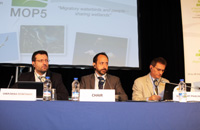
At the invitation of the Government of France, the meeting took place from 14 to 18 May 2012 in La Rochelle, a seaport and major conference centre on the French Atlantic coast. The international conference brought together more than 200 participants, including conservation experts and government representatives of both AEWA Contracting Parties and non-Party Range States. The theme for MOP5 was “Migratory waterbirds and people - sharing wetlands”.
The meeting was preceded by an African regional preparatory workshop aimed at revising and validating a draft Plan of Action (PoA) for Africa, the focus of which is to promote the implementation of AEWA in the African region. This Plan of Action for Africa includes a set of concrete measures related, among others, to monitoring, knowledge building, awareness raising and more international cooperation.
 Thirteen per cent of all AEWA waterbird populations occurring
in Africa are globally threatened. Waterbird populations
are depleted in the region as a result of the degradation
of habitats including wetlands such as marshes, mangroves
and estuaries, which used to provide adequate food sources.
Only 10 per cent of wetlands in Africa enjoy the status
of protected areas. Both humans and birds depend on wetlands
and freshwater to survive.
Thirteen per cent of all AEWA waterbird populations occurring
in Africa are globally threatened. Waterbird populations
are depleted in the region as a result of the degradation
of habitats including wetlands such as marshes, mangroves
and estuaries, which used to provide adequate food sources.
Only 10 per cent of wetlands in Africa enjoy the status
of protected areas. Both humans and birds depend on wetlands
and freshwater to survive.
Close to €10 million are needed to be able to implement the Plan of Action for Africa over its five-year period 2012 – 2017. Countries clearly stated that more support is needed to ensure the effective implementation of the plan.
In total, 27 resolutions were approved by the Parties at MOP5 with topics ranging from the impacts on migratory waterbirds of power lines, extractive industries, renewable energy, agrochemicals, alien species and climate change to the importance of waterbird monitoring and the promotion of twinning schemes.
 MOP5 also adopted International Single Species Action
Plans for the Greenland White-fronted Goose (Anser
albifrons flavirostris), Sociable Lapwing (Vanellus
gregarius),
Red-breasted Goose (Branta ruficollis), Slaty
Egret (Egretta
vinaceigula) and Bewick’s Swan (Cygnus
columbianus)
and the first AEWA International Management Plan for
the Svalbard population of the Pink-footed Goose (Anser
brachyrhynchus). Among the meeting’s main
achievements were also the adoption of Resolutions on
the further
joint implementation of AEWA and the Ramsar Convention,
amendments to the AEWA Action Plan and the implementation
and revision of the AEWA Communication Strategy.
MOP5 also adopted International Single Species Action
Plans for the Greenland White-fronted Goose (Anser
albifrons flavirostris), Sociable Lapwing (Vanellus
gregarius),
Red-breasted Goose (Branta ruficollis), Slaty
Egret (Egretta
vinaceigula) and Bewick’s Swan (Cygnus
columbianus)
and the first AEWA International Management Plan for
the Svalbard population of the Pink-footed Goose (Anser
brachyrhynchus). Among the meeting’s main
achievements were also the adoption of Resolutions on
the further
joint implementation of AEWA and the Ramsar Convention,
amendments to the AEWA Action Plan and the implementation
and revision of the AEWA Communication Strategy.
For more information about MOP5 and its outcomes please read the daily coverage of MOP5 by the Earth Negotiations Bulletin (ENB) and visit our special MOP5 multimedia page including a comprehensive photo gallery. Video interviews of a number of MOP5 participants can also be watched on youtube.com through the AEWA channel.
For further information please visit also: